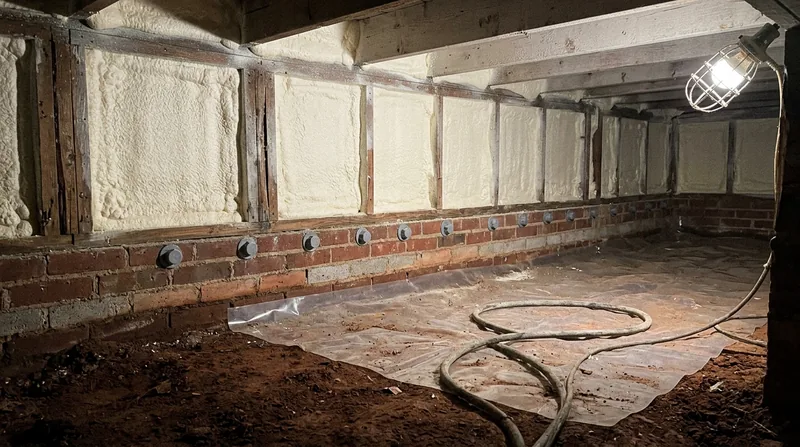




Winston-Salem's building stock tells the story of why wall and injection foam insulation matters here. The mill houses of Ardmore and Washington Park, the 1900s Craftsman bungalows that line the neighborhoods west of downtown, the brick-veneer ranches that fill Kernersville and Thomasville from the 1950s onward, and the post-war split-levels across Konnoak Hills all share a common problem: closed walls with no insulation, no air sealing, and no way to fix it without tearing down drywall. The humid Piedmont climate, summer temperatures that bake into the 130s to 150s in uninsulated attics, and the winter ice storms that roll off the Blue Ridge foothills mean every unsealed wall cavity is a thermal leak and a moisture path. Injection foam fills those cavities through small ports drilled from the outside, no demolition, no disruption. It is the only retrofit answer for the solid brick and timber-frame buildings Old Salem preserves, and it is the honest answer for thousands of homes across Greater Winston-Salem that were built before insulation standards existed.
Why Wall & Injection Foam Insulation Matters in Winston-Salem's Older Neighborhoods
The homes that define Winston-Salem's character, from the Moravian brick of Old Salem and Bethania to the frame mill houses on brick piers, were built to stay cool by cross-ventilation and to shed water by gravity. They were not built to insulate. A 1920s Craftsman bungalow in Ardmore or a 1950s ranch in Thomasville with hollow brick walls or frame walls stuffed only with newspaper and sawdust loses heat through every exterior wall in winter and absorbs it in summer. The humid subtropical climate means moisture moves through those walls year-round, and the red clay foundation of the Piedmont sits on vented crawl spaces where humidity creeps upward. Injection foam seals the cavity, stops air movement, and resists moisture. It does not require demolition, does not disturb plaster or original trim, and leaves no visible scar.
- Fills wall cavities from the outside through small ports, no interior drywall removal needed.
- Stops air leakage and thermal bridging through solid brick, frame, or mixed-construction walls.
- Controls moisture movement in the humid Piedmont climate without trapping water inside the wall.
- Preserves the historic integrity of Old Salem, Bethania, and other protected neighborhoods where interior work is restricted.
- Works on homes built before 1980 when insulation codes were minimal or nonexistent.
Injection foam is the retrofit solution that respects the building you have.
Key info: A 1920s Ardmore bungalow with solid brick walls cannot be retrofitted with batts or blown-in insulation. Injection foam through small exterior ports fills the cavity without disturbing the plaster, trim, or the character that makes the neighborhood worth living in. Ports are patched and painted to match.
How Injection Foam Insulation Works in Winston-Salem Homes
Injection foam is a precision process, not a spray-and-go operation. The wall cavity is drilled from the outside at intervals, the foam is injected under controlled pressure to fill the void, and the ports are patched. The foam expands slightly to fill gaps and contact every surface of the cavity, sealing air leakage while the material cures. The key difference from spray foam in open cavities is that injection happens in a closed, confined space where the foam cannot see and cannot be visually inspected during application. This means the installer must understand the wall construction, the foam system, and the pressure and temperature controls that ensure a complete fill without voids, cracks, or blowouts.
- We inspect the wall from the exterior to identify the cavity type, wall thickness, and any obstructions like blocking, wiring, or plumbing.
- We drill small ports (typically 1 to 2 inches) at intervals along the wall, spacing determined by cavity depth and foam expansion rate.
- We inject foam under controlled pressure and temperature, filling from bottom to top to displace air and ensure complete coverage.
- We allow the foam to cure per manufacturer specs, typically 24 to 48 hours, with mechanical ventilation during and after application.
- We patch all ports with foam-compatible filler, sand smooth, and paint to match the existing exterior finish.
The result is a sealed, insulated wall cavity that stops air leakage and thermal bridging without any interior disruption.
Example: A 1960s brick-veneer ranch in Kernersville with frame walls in the living room addition has cold spots along the rim and the band joist where the wall meets the foundation. Injection foam fills the frame wall cavity from the exterior, seals the rim joist, and stops the draft. The homeowner sees no interior work, no mess, and the exterior ports are patched and painted. For more on sealing the rim and band joist specifically, see our rim joist and band joist spray foam insulation page.
Injection Foam vs. Other Wall Insulation Methods: Which Works for Your Winston-Salem Home
| Method | How It Works | Best For |
|---|---|---|
| Injection Foam (Closed Cell or Open Cell) | Injected through small ports into closed cavities, no demolition, cures in place. | Retrofit of existing frame or solid brick walls, historic homes, preservation neighborhoods. |
| Blown-In Cellulose or Fiberglass | Blown through holes in drywall, settles over time, requires drywall repair. | Interior retrofit when exterior access is impossible and drywall removal is acceptable. |
| Spray Foam (Open Cell) | Sprayed into open cavities during new construction or demolition, expands, cures in place. | New construction, additions, or full interior renovation where walls are open. |
| Solid Brick with No Interior Access | Solid Moravian brick or timber-frame buildings with no cavity to fill. | Interior insulation only (rigid foam board on interior face) or exterior work that respects historic fabric. |
Injection foam is the answer when you have a wall cavity, exterior access, and no appetite for interior demolition. For solid brick buildings like those in Old Salem, we will tell you honestly that injection is not an option, and we will discuss what is.
Wall & Injection Foam Insulation Cost in Winston-Salem: What to Expect
Injection foam insulation is priced by the square foot of wall surface, starting at around $2 per square foot for straightforward frame walls with good exterior access. A typical 1950s ranch with a 1,200-square-foot perimeter and 8-foot walls would run between $1,900 and $2,400 in material and labor, depending on wall type, cavity depth, and the number of obstructions inside the wall. A smaller Ardmore bungalow or a partial retrofit of a single addition may cost less; a multi-story home or a building with complex wall construction, multiple materials, or difficult exterior access will cost more. The estimate is the only honest way to know the price for your specific home.
Several factors move the cost up or down. Frame walls with a clear cavity are faster and cheaper than brick-veneer walls where the foam must fill the cavity between the brick and the sheathing. Walls with electrical wiring, plumbing, or blocking inside the cavity take longer to inject and may require careful planning to avoid damage. Easy exterior access (no landscaping, no vinyl siding that requires removal) keeps labor time down. A two-story wall or a wall below grade takes more injections and more material. Getting two or three estimates from different contractors is the smart move. Each estimate should specify the wall type, the cavity depth, the number of ports, the foam type (closed cell or open cell), and the R-value per inch so you can compare apples to apples.
For a detailed pricing overview and to request a free, written estimate with R-value and thickness specifications, visit our pricing page or call (336) 608-5235.
Wall & Injection Foam Insulation Near Me: What to Look for When Hiring a Contractor in Winston-Salem
The spray foam trade has two poles: the rig-and-run crew that rolls into town in an out-of-state trailer, sprays a job in an afternoon, and is unreachable when the smell will not go away or the foam cracks; and the national franchise that subcontracts to whoever is cheapest. A local independent contractor is your best bet. Here is what to verify before you sign a contract. First, confirm that the contractor is fully insured and can provide a certificate of insurance that names you as an additional insured during the work. Ask for references from homeowners in Winston-Salem, Clemmons, or Kernersville where they have done injection foam work, and call them. A real contractor will have them; a crew passing through will not. Second, get a written estimate that includes the wall type, cavity depth, number of ports, foam type, R-value per inch, and thickness per pass. An estimate with no R-value and no thickness is a red flag. Third, understand the permits that apply at your address. Winston-Salem, Clemmons, Kernersville, and Thomasville each have different building departments, and some neighborhoods have HOA rules that govern exterior work. We help you navigate what applies to your home, and we defer to the local building official. Fourth, ask about the cure process. Mechanical ventilation during application and a 24 to 48-hour re-entry window are the standard; if a contractor promises immediate re-entry or says ventilation is not needed, walk away.
The honest contractor will also tell you when injection foam is not the right answer. Solid brick buildings like those in Old Salem and Bethania cannot be injected. Walls with moisture or active leaks need the leak fixed first, or we do not spray. A wall with settling or structural damage needs structural repair before any insulation goes in. If a contractor glosses over these issues or promises to fix them with foam, that is a sign they are more interested in the sale than the job.
To request a free estimate and speak with a local contractor who knows Winston-Salem's homes, contact us at (336) 608-5235. We will ask the right questions, look at the wall, and tell you what works and what does not.
Wall & Injection Foam Insulation in Winston-Salem: Pricing Guide
| Service | Price | Details |
|---|---|---|
| Injection Foam, Frame Walls | Starting at $2/sq ft | Standard frame wall retrofit with good exterior access, no obstructions, straightforward cavity fill. |
| Injection Foam, Brick-Veneer Walls | Starting at $2.50/sq ft | Dual-cavity walls (brick plus frame) require more injection points and careful pressure control to fill both layers. |
| Complex Wall Retrofit (Multi-Story, Difficult Access, Obstructions) | On estimate | Electrical wiring, plumbing, blocking, or difficult exterior access require on-site assessment before pricing. |
| Travel and Mobilization | Included | No separate charge for travel within Winston-Salem and surrounding service areas listed on our site. |
| Free Written Estimate | Free | Includes R-value, thickness, wall type, and cavity depth. Response within 24 hours, no obligation to book. |
Indicative pricing, the exact cost depends on square footage, finish, and site access. Free personalized estimate within 24h at (336) 608-5235.


