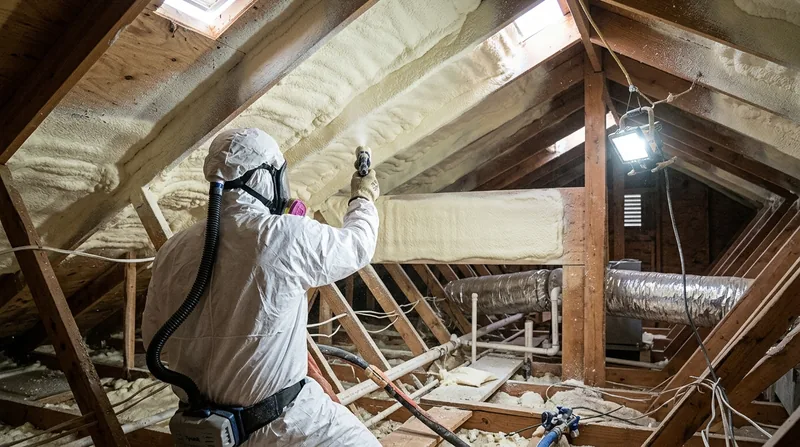




Winston-Salem's sprawling neighborhoods run thick with vented attics that climb to 130 to 150 degrees Fahrenheit through the humid Piedmont summers. Most of those attics house the air handler and ductwork that cool the homes below, and the gap between conditioned space and unconditioned attic costs money every month. Attic spray foam insulation seals and insulates the roof deck itself, turning that baking space into part of the thermal envelope and moving the HVAC equipment inside the climate boundary. From the 1920s brick Colonials of Reynolda to the 1980s split-levels of Konnoak Hills and the newer two-stories of Clemmons and Bermuda Run with their finished rooms over the garage, the problem is the same: heat loss in winter, heat gain in summer, and humidity that fiberglass batts cannot control. We spray open-cell or closed-cell foam directly onto the roof sheathing, seal every penetration and rim, and deliver an estimate that names the R-value, the thickness per pass, and the board footage. This is the work that matters in the Triad.
Why Attic Spray Foam Insulation Matters in Winston-Salem's Climate
The Piedmont climate brings long, sticky summers and winters with ice storms and occasional snow off the Blue Ridge foothills. Humidity is the driver. Fiberglass batts and blown-in cellulose do not stop air movement or moisture diffusion the way foam does, and when your air handler sits in a vented attic, every cubic foot of warm, humid air that leaks past the ceiling joists costs you twice: once in the cooled air itself, and again in the moisture that condenses on the back side of your roof sheathing. Spray foam seals and insulates at the same time. Every attic we treat starts with a walk-through to check for active leaks, roof penetrations, soffit vents, and the rim where the attic meets the exterior walls.
- We identify all air leakage paths where unconditioned air enters the attic from outside or from the living space below.
- We seal rim joists, band joists, soffit vents, and penetrations around plumbing vents and electrical conduit before we foam.
- We spray the roof deck to the R-value your home needs, measured in board feet and thickness per pass, with mechanical ventilation running during cure.
- We deliver a written estimate that names the R-value target, the thickness, and the total board footage so you know what you are paying for.
The result is a conditioned attic that stops the temperature swings that age your roof and your HVAC system, and that keeps humidity out of the building envelope.
Key info: Winston-Salem's red-clay soil and brick-pier crawl spaces mean moisture moves upward through the foundation. A sealed attic stops the suction that pulls humid air from the crawl space into the living space and then into the attic, where it condenses on cool roof sheathing during air conditioning season.
For more detail on how air sealing works with spray foam, see our air sealing service page.
How We Spray Attic Foam in Winston-Salem: The Process
Every attic is different. Some have existing blown-in insulation that needs removal. Some have active roof leaks or moisture damage. Some have solid knob-and-tube wiring or asbestos-containing materials that require careful handling. We start with a detailed site visit, photograph the conditions, and build an estimate around what is actually there. If moisture or contamination is present, we address it first or we recommend a specialist. If the substrate is sound and dry, we proceed to spray.
- We remove existing insulation if it is failed, contaminated, or in the way of the foam application, using proper containment and disposal.
- We seal all air leakage paths: rim joists, band joists, soffit vents, plumbing vents, electrical penetrations, and the junction where the attic meets exterior walls.
- We set up mechanical ventilation to run during the cure cycle, typically 24 to 48 hours depending on foam type and ambient conditions.
- We spray the roof deck to the specified R-value and thickness, using the correct drum temperature and material ratio per the manufacturer's system.
- We install the thermal barrier required by code (a fifteen-minute fire rating, not a smoke barrier), typically a half-inch drywall or a spray-applied intumescent coating.
- We check the depth across the attic and walk you through the finished work, including the thickness and R-value installed.
The entire process takes one to three days for a typical attic, depending on size and how much existing insulation needs removal. We schedule the work to minimize disruption to your household.
Example: A 1950s brick ranch in Kernersville with 1,200 square feet of attic space, existing fiberglass batts, and a vented roof deck typically takes two days: Day One for removal, sealing, and setup; Day Two for the foam spray and thermal barrier. The homeowner stays out of the attic for 48 hours while the foam cures and offgassing occurs. We use open-cell foam for this job because the attic will remain unconditioned (soffit vents stay open) and open-cell is cheaper and adequate for the R-value needed.
To understand the difference between open-cell and closed-cell foam and which suits your home, visit our open-cell spray foam page or our closed-cell spray foam page.
| Approach | Description | Best for |
|---|---|---|
| Open-Cell Foam on Vented Attic | Low-density foam sprayed to R-19 to R-38 on the roof deck; soffit vents remain open to allow roof sheathing to dry; vapor-permeable and cost-effective. | Attics that will stay vented; homeowners who prioritize cost; homes where the air handler stays in the attic but soffit vents are needed for roof durability. |
| Closed-Cell Foam on Sealed Roof Deck | High-density foam sprayed to R-30 to R-60; seals the entire roof deck and rim; soffit vents are blocked; provides air barrier and moisture control; more expensive but conditioned attic is possible. | Sealed attics where the air handler and ductwork move inside the envelope; homes with moisture problems; metal buildings and barndominiums where condensation control is critical. |
| Insulation Removal and Replacement | Fiberglass batts or blown cellulose removed, attic vacuumed and sealed, then foam sprayed; handles failed or contaminated existing insulation. | Attics with settled blown-in insulation, water-damaged batts, or insulation that has been compressed by foot traffic. |
| Top-Up Foam Over Sound Insulation | Thin layer of open-cell foam sprayed over existing fiberglass or cellulose to add R-value and seal air leakage; existing insulation stays in place. | Homes where existing insulation is sound but R-value is low; budget-conscious retrofits where full removal is not needed. |
Attic Spray Foam Insulation Cost in Winston-Salem: What to Expect
Spray foam pricing depends on the R-value target, the board footage, access to the attic, and whether existing insulation needs removal. Most attic jobs in the Winston-Salem area start at $1.50 per square foot for a straightforward open-cell application on a clean, accessible attic. Closed-cell foam costs more because the material itself is more expensive and the application is more precise. Removal of existing insulation adds cost and time. Attics that are tight, cluttered with HVAC ducts and plumbing, or have active moisture issues require more labor and may need a specialist first.
We always provide a written estimate before we start work. The estimate includes the R-value you are paying for, the thickness per pass, the total board footage, and the labor and material breakdown. We do not surprise you with add-ons at the end. To see our full pricing overview and to request a free estimate, visit our pricing page.
A typical 1,500-square-foot attic with open-cell foam to R-30 and no removal runs $2,000 to $3,000. A sealed attic with closed-cell foam to R-40 and full insulation removal runs $4,500 to $6,500. These are ballpark figures. Actual price depends on the site visit. Call us at (336) 608-5235 for a free, no-obligation estimate within 24 hours.
Attic Spray Foam Insulation Near Me: What to Look for When Hiring a Contractor in Winston-Salem
Spray foam is not a DIY job. The equipment is expensive, the material ratio and drum temperature must be exact, and the cure environment must be controlled. When you hire a contractor, verify that they are fully insured, that they can show you a detailed estimate with R-value and thickness, and that they have references from recent jobs in your area. Ask about their process for managing offgassing and re-entry windows. Do not hire based on price alone. A bid far below market usually means the contractor is cutting corners on material ratio, ventilation during cure, or thermal barrier installation.
In Winston-Salem, some attics are in historic homes or HOAs that have architectural rules. The foam itself is not usually restricted, but exterior work on metal buildings in master-planned areas may need approval. Ask us about your specific situation. We will help you understand what applies at your address and what permits or notifications are needed. Call us at contact us for a free estimate and we will walk you through the process.
- Request a written estimate that lists the R-value target, the thickness per pass, and the total board footage so you can compare apples to apples.
- Ask the contractor whether they will use mechanical ventilation during cure and what the re-entry window is (typically 24 to 48 hours).
- Verify that the contractor is fully insured and ask to see a certificate of insurance naming your address.
- Check references from at least two jobs done in the last year in Winston-Salem or nearby towns.
- Understand what permits apply at your address by asking the contractor to explain what the local building department requires (this varies by city and neighborhood).
- Ask whether the estimate includes the thermal barrier required by code and what material will be used (drywall or intumescent coating).
The strongest signal of a professional spray foam installer is a detailed estimate with no vague language, mechanical ventilation during cure, and a realistic re-entry window. If a contractor promises immediate occupancy or cannot name the R-value and thickness, move on.
Attic Spray Foam Insulation in Winston-Salem: Pricing Guide
| Service | Price | Details |
|---|---|---|
| Open-Cell Spray Foam, Vented Attic | Starting at $1.50/sq ft | Clean, accessible attic with no existing insulation removal needed; soffit vents remain open; typical R-19 to R-30 application |
| Closed-Cell Spray Foam, Sealed Attic | Starting at $2.75/sq ft | Higher density material; seals entire roof deck and rim joists; allows conditioned attic with air handler and ductwork inside envelope |
| Insulation Removal and Replacement | From $0.75/sq ft removal plus foam cost | Includes vacuum removal of existing blown-in cellulose or fiberglass batts, attic cleaning and sealing, then new foam application |
| Sealed Attic with Closed-Cell and Thermal Barrier | On estimate | Complex jobs requiring full removal, moisture assessment, sealed rim and soffit, code-required thermal barrier, and mechanical ventilation during cure |
| Travel and Estimates | Included in Winston-Salem area | Free, no-obligation written estimate within 24 hours; no travel fees or mileage charges for service areas |
Indicative pricing, the exact cost depends on square footage, finish, and site access. Free personalized estimate within 24h at (336) 608-5235.


