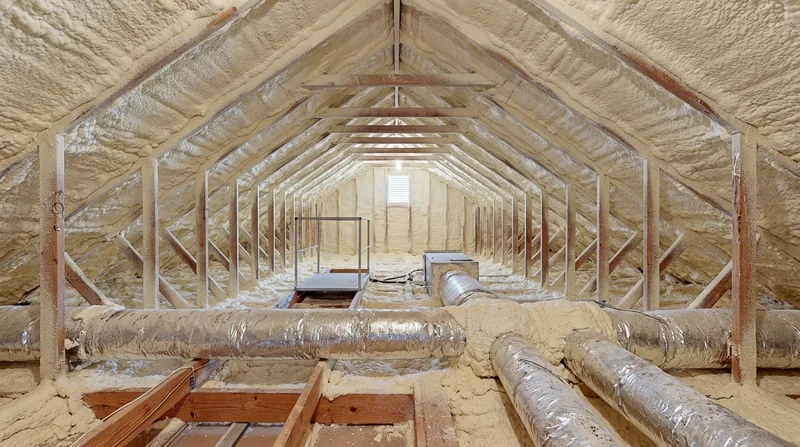




Open cell spray foam insulation in Winston-Salem is the cost-effective air-sealing choice for attics and walls where the Piedmont's humid summers and the stack effect through vented attics drive energy loss year-round. Winston-Salem's landscape rolls across red clay beneath the Blue Ridge foothills, and most homes sit in vented attics that bake at 130 to 150 degrees Fahrenheit through long, muggy summers, with air handlers and ductwork leaking into unconditioned space. Half-pound open-cell foam seals those leaks at a friendlier price per board foot than closed-cell, and it brings sound dampening between rooms as a bonus. We spell out where open cell belongs, where a damp crawl space or a metal building calls for closed cell instead, and when blown-in fiberglass is the smarter move on a sound attic needing only a top-up. Call us at (336) 608-5235 for a free written estimate with R-value and thickness specs, or read on to understand what the work involves and what it costs in your neighborhood.
Why Open Cell Spray Foam Insulation Matters in Humid Winston-Salem Attics
A vented attic in Winston-Salem is a thermal sieve. Hot, humid air leaks past every seam in the ceiling plane, past the rim joist, past the ductwork, and into the conditioned space below. Open-cell foam seals those paths at the source, tightens the envelope, and reduces the load on the air handler through the cooling season. Unlike fiberglass batts, which settle and gap, foam expands to fill every corner, every wire chase, and every pipe penetration. The North Carolina Piedmont's humidity means that vapor permeability matters too: open-cell foam is vapor-open, which allows any moisture that does find its way into the attic to dry back out rather than trap it, a critical advantage in a climate where summer dew points run 65 to 70 degrees Fahrenheit.
- Open-cell foam expands to fill gaps, sealing leaks that batts and blown-in cannot reach.
- Vapor-open construction dries moisture back out in humid climates rather than trapping it.
- Sound dampening between stories comes with the product, reducing footfall and HVAC noise.
- Lower cost per board foot makes it the price-friendly choice for attics where closed cell is not required.
- Proper installation includes controlled thickness per pass, mechanical ventilation during cure, and a twenty-four to forty-eight hour re-entry window.
The work is straightforward: we remove old insulation if needed, seal air leaks, spray to the specified thickness, and let the foam cure under ventilation before you re-enter the space. Learn more about the full range of attic solutions at our attic spray foam insulation page.
Key info: The North Carolina building code and the local building official in your city govern attic ventilation, ignition barriers, and thermal barriers. Open-cell foam requires a thermal barrier when exposed to living space; permitting and inspection vary by jurisdiction. We help you navigate what applies at your address and defer all code questions to the building department.
For detailed guidance on contractor qualifications and what to verify before hiring, visit the North Carolina Department of Commerce occupational licensing page.
How We Install Open Cell Spray Foam Insulation in Winston-Salem Homes
The installation follows a strict sequence. First, we inspect the attic for moisture, active leaks, or contamination. If the substrate is wet, we walk away: foam does not fix a roof leak or standing water, and spraying over damp wood sets up failure. Next, we identify and seal the major air leaks with caulk or foam closure strips. Then we set up mechanical ventilation in the attic space to manage off-gassing during cure. We spray open-cell foam to the specified thickness, typically 5 to 6 inches for R-19 to R-24 in a single pass, controlling the spray gun distance and the ratio of resin to catalyst. After cure, we verify thickness with a depth gauge, and we post a re-entry window of twenty-four to forty-eight hours before the space is safe for occupancy.
- We inspect the attic for moisture, leaks, and contamination before any work begins.
- We seal major air leaks with caulk or closed-cell foam closure strips to maximize the benefit.
- We set up mechanical ventilation in the attic to manage off-gassing during the cure period.
- We spray open-cell foam to the specified thickness and R-value, controlling gun distance and drum temperature.
- We verify thickness with a depth gauge and provide a written re-entry window before you re-occupy the space.
Every estimate includes the R-value and thickness we propose, so you know exactly what you are getting. See how this process fits into a larger air-sealing strategy on our air sealing page.
Example: A 1960s split-level in Konnoak Hills with a 1,200-square-foot vented attic and flattened original fiberglass insulation typically receives 5 inches of open-cell foam, yielding R-19 to R-22 depending on the foam system. Cost runs from 800 to 1,200 dollars. The job takes one day. Cure time is twenty-four to forty-eight hours, and the homeowner avoids the mess and settling of blown-in fiberglass.
| Approach | Description | Best for |
|---|---|---|
| Open-cell spray foam | Half-pound foam sprayed to 5 to 6 inches, R-19 to R-24, vapor-open, sound-dampening. | Vented attics, interior walls, and price-conscious retrofits in dry climates or above living space. |
| Closed-cell spray foam | Two-pound foam sprayed to 3 to 4 inches, R-24 to R-28, vapor-closed, moisture-resistant. | Crawl spaces, basements, metal buildings, sealed attics, and condensation-prone environments. |
| Blown-in fiberglass or cellulose | Loose-fill insulation air-blown to 8 to 12 inches, R-25 to R-38, settles over time. | Top-ups of existing sound attics where air sealing is not the priority and cost is the constraint. |
| Insulation removal and replacement | Mechanical removal of failed, contaminated, or settled insulation followed by new foam or blown-in. | Attics with mold, rodent damage, or fiberglass that has lost R-value and air-sealing capability. |
Open Cell Spray Foam Insulation Cost in Winston-Salem: What to Expect
Open-cell spray foam in Winston-Salem starts at approximately 0.55 dollars per board foot and ranges upward based on job size, attic accessibility, and the thickness required to meet your target R-value. A typical 1,200-square-foot attic with 5 inches of open-cell foam (R-19 to R-22) costs between 800 and 1,400 dollars, depending on the complexity of air sealing, the amount of old insulation to remove, and site access. Smaller jobs, like sealing a rim joist or a garage ceiling, run 300 to 600 dollars. Larger homes or projects requiring insulation removal first may cost more. The best way to lock in a firm price is to get a free written estimate on site: we measure the space, specify the R-value and thickness, and quote labor and material together.
Factors that move the cost up include old insulation that must be removed, difficult attic access (low headroom, tight eaves, or obstacles), air sealing work beyond the foam itself, and the need for mechanical ventilation setup during cure. Factors that hold cost down include a clean, dry attic with good access and a straightforward foam-only scope. We always provide a breakdown so you understand what you are paying for. For detailed pricing across all our services, visit our pricing page.
Getting two or three estimates from different contractors is smart. Watch for red flags: an estimate with no R-value and no thickness spec, a price far below market with no inspection, or a promise of immediate re-entry without a cure window. The honest position, which is also the strongest selling point of a local shop, is correct installation: controlled thickness per pass, the manufacturer ratio and drum temperature, mechanical ventilation during cure, and a stated re-entry window of twenty-four to forty-eight hours. That takes time and costs money, and it is the only way the foam performs as designed.
Open Cell Spray Foam Insulation Near Me: What Winston-Salem Homeowners Should Know When Hiring
Hiring a spray foam contractor in Winston-Salem or the surrounding Piedmont towns like Clemmons, Kernersville, and High Point requires the same due diligence as any home improvement. The market includes local independent shops, regional franchises, and out-of-state crews that spray a job in an afternoon and disappear. The differentiator is not the rig on the trailer but the behavior and technique on the job: proper air sealing, controlled spray thickness, mechanical ventilation during cure, and a stated re-entry window. Before you book, ask the contractor for an estimate that includes the R-value and thickness in writing, a timeline for cure and re-entry, and proof of insurance. Verify that any contractor you hire has full insurance coverage and can provide a certificate of insurance on request. Ask for references, and call them to ask about the quality of the installation, whether the job was clean, and whether the contractor was reachable if questions came up after the work.
- Request a written estimate that specifies the R-value, thickness in inches, and the total board feet.
- Ask for proof of full insurance coverage and a certificate of insurance before any work begins.
- Call at least two references and ask about job quality, cleanliness, and post-job communication.
- Verify that the contractor understands the local building code and the permitting requirements in your city.
- Confirm the cure time and re-entry window in writing before the work starts, and avoid any contractor who promises immediate re-entry.
- Check whether your HOA has architectural rules that govern exterior work on metal buildings or other structures on your property.
We are fully insured and have been installing spray foam in the Piedmont since 2012. Every estimate includes R-value and thickness specs, and every job includes a written re-entry window. Call us at (336) 608-5235 or visit our contact page to request a free estimate, no obligation.
Open Cell Spray Foam Insulation in Winston-Salem: Pricing Guide
| Service | Price | Details |
|---|---|---|
| Open-cell attic spray foam | Starting at $0.55/board ft | 5 to 6 inches for R-19 to R-24, includes basic air sealing around penetrations |
| Attic with old insulation removal | Starting at $0.65/board ft | Mechanical removal of failed fiberglass or cellulose, disposal, then open-cell foam application |
| Wall or rim joist injection foam | Starting at $0.75/board ft | Closed-cell foam for moisture-prone areas, higher R-value per inch, typically 2 to 3 inches |
| Large or complex project | On estimate | Metal building, sealed attic, or crawl space requiring closed-cell foam or extensive air sealing work |
| Travel and service call | Included | No mileage fee or travel charge within Winston-Salem and surrounding Piedmont service areas |
| Free written estimate | Free | Response within 24 hours at (336) 608-5235, includes R-value and thickness specifications |
Indicative pricing, the exact cost depends on square footage, finish, and site access. Free personalized estimate within 24h at (336) 608-5235.


