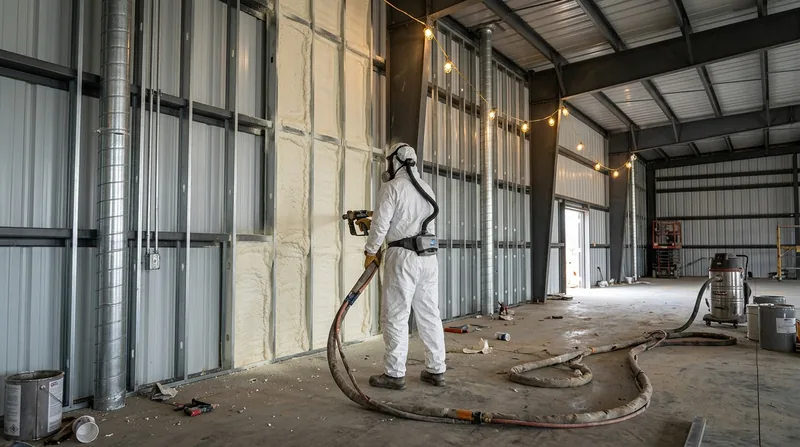




Commercial and new construction spray foam insulation in Winston-Salem means controlling moisture, thermal bridging, and air leakage in warehouses, offices, churches, and production facilities across the Piedmont. The region's humid subtropical climate, rolling terrain, and year-round building activity create steady demand for code-compliant foam assemblies that local building inspectors will actually approve. From the Innovation Quarter's converted tobacco factories to High Point's furniture showrooms and the Union Cross distribution belt, commercial shells demand phased work that keeps operations running and documentation that satisfies the building department. We handle closed-cell and open-cell applications, sealed roof decks, wall cavities, and rim band work on schedule, with written estimates that specify R-value and thickness so your permit process moves without friction.
Why Commercial and New Construction Spray Foam Matters in Winston-Salem
Warehouses and production buildings in this region sit exposed to temperature swings and moisture that fiberglass and blown-in cellulose simply cannot handle. The humidity that drives crawl space mold in residential work is the same force that condenses on metal roof decks and uninsulated walls in commercial shells. Closed-cell foam creates a continuous air barrier and vapor retarder in a single pass, eliminating the thermal bridging and air leakage that shows up as hot spots on thermal images and cold zones on the shop floor. New construction framing and sealed attics benefit from the same science: one application, one thickness, one R-value per square inch, no gaps.
- Closed-cell foam stops thermal bridging through rim joists, band boards, and header cavities that would otherwise leak conditioned air.
- Sealed roof decks eliminate the vented attic entirely, moving the thermal envelope to the roof plane and preventing the 130-150 degree summer heat that burns through standard insulation.
- Open-cell foam in interior walls and ceilings provides acoustic dampening while meeting code thermal requirements at a lower cost per board foot.
- Phased work sequences allow your operation to continue without shutdown, with mechanical ventilation during cure and controlled re-entry windows.
- Written estimates with R-value and thickness specifications satisfy building departments and give you the documentation your inspector expects to see.
Code compliance and builder confidence begin with an insulation contractor who speaks the building official's language and delivers paperwork that closes permits.
Key info: North Carolina building code governs thermal barrier requirements, ignition barriers, and ventilation rules at your address. We defer to your local building department in Winston-Salem, Clemmons, High Point, or any service area. Visit your city's building permits office to confirm what applies to your project before we estimate.
For detailed permit guidance, consult the City of Winston-Salem Building and Development Services or your local municipal office.
How We Install Commercial and New Construction Spray Foam in Winston-Salem
Our process begins on site with a measurement and moisture assessment. We determine the substrate condition, identify any wet or contaminated areas that must be addressed first, and lay out the spray sequence so your building stays operational. We confirm drum temperature, equipment ratio, and mechanical ventilation requirements before the first pass. Thickness is controlled per manufacturer specification, and we document everything so your building department has the record it needs.
- We assess the substrate and moisture condition on the first visit, and walk away from wet or leaking surfaces until they are repaired.
- We set up mechanical ventilation and establish a re-entry window of 24 to 48 hours, posted on site so occupants know when the space is safe.
- We spray in controlled passes, measuring thickness at each stage to hit the R-value your estimate specifies.
- We document board footage, R-value, and application date on a certificate that goes to the building department with your permit closeout.
- We perform final inspection with you and the building official if required, answering technical questions about installation and system performance.
The result is a sealed thermal envelope with no gaps, no thermal bridging, and paperwork that satisfies code and closes your permit file.
Example: A High Point furniture showroom with 8,000 square feet of roof deck and 2,000 board feet of closed-cell foam took three days of phased spray work, with the shop floor open to staff on day four. The sealed deck eliminated the vented attic heat load, and the written estimate with R-30 specification and application date satisfied the building inspector's permit closeout in one review cycle.
Learn more about our closed-cell spray foam insulation and how it performs in sealed roof assemblies.
Commercial and New Construction Spray Foam Application Methods
| Approach | Description | Best for |
|---|---|---|
| Closed-Cell Spray Foam | High-density foam (1.5 to 2 lbs/cu ft) with closed cell structure; acts as air barrier and vapor retarder in one pass; R-6 to R-7 per inch. | Sealed roof decks, metal building condensation control, rim and band joists, new construction where continuous air sealing is required. |
| Open-Cell Spray Foam | Low-density foam (0.4 to 0.5 lbs/cu ft) with open cell structure; allows vapor diffusion; R-3.5 to R-3.7 per inch; provides acoustic dampening. | Interior walls and ceilings in conditioned spaces, sound-dampening applications, retrofit work where cost per R-value is a priority. |
| Wall Cavity and Injection Foam | Low-pressure injection into existing wall cavities without demolition; fills voids and eliminates air leakage in solid walls; both open and closed cell available. | Pre-1980 commercial retrofit, historic buildings where exterior walls cannot be disturbed, new construction wall cavities during framing phase. |
| Rim and Band Joist Sealing | Closed-cell foam applied to rim board and band joist cavities to eliminate thermal bridging and air leakage; typically 1.5 to 2 inches thick. | New construction and retrofit projects where thermal bridging through foundation connections drives energy loss and condensation risk. |
| Insulation Removal and Replacement | We remove failed fiberglass, cellulose, or old foam; dispose of it properly; and install new spray foam in a single project sequence. | Retrofit of failed or settling insulation, upgrade of existing attics or cavities to spray foam performance, clearance of contaminated material. |
Each method is selected based on the building's thermal envelope, moisture profile, code requirements, and operational constraints. We specify the application and thickness in writing before any work begins.
Commercial and New Construction Spray Foam Cost in Winston-Salem: What to Expect
The cost of commercial and new construction spray foam in Winston-Salem depends on board footage, foam type (closed-cell or open-cell), substrate condition, access, and complexity of the assembly. A warehouse sealed roof deck with 2,000 to 4,000 board feet of closed-cell foam will cost more than an office interior wall cavity with open-cell injection foam. Site conditions matter: if the substrate is wet, contaminated, or requires structural repair before foam can be applied, the project cost rises. We provide a free commercial estimate with R-value and thickness specifications so you know exactly what you are paying for before we begin.
- Board footage is measured on site and is the primary cost driver for any spray foam project.
- Closed-cell foam costs more per board foot than open-cell, but delivers higher R-value and acts as an air barrier and vapor retarder simultaneously.
- Substrate preparation, moisture remediation, and thermal barrier installation (if required by code) are factored into the estimate and can affect the final price.
- Phased work, mechanical ventilation, and permit documentation are included in the scope and the estimate.
- Travel within Winston-Salem and surrounding service areas is included; no mileage surcharge or call-out fee applies.
The most common mistake is comparing price per board foot without understanding the foam type, R-value, and substrate condition. Our estimate gives you those details in writing so you can compare apples to apples with other bids.
For a realistic sense of commercial spray foam pricing in your market, visit our pricing overview and call us at (336) 608-5235 for a free estimate tailored to your building.
What to Look for When Hiring a Spray Foam Contractor Near Winston-Salem
The spray foam trade has two poles: rig-and-run crews that spray a job in an afternoon with no follow-up, and national franchises that may not be local to your building department. A local independent contractor with a local address, local plates, and a history in Winston-Salem knows the building officials, the code variations between cities, and the moisture challenges of the Piedmont. When you call a contractor, ask for an estimate with R-value and thickness written down, proof of insurance, and references from recent commercial jobs. Never accept a price per board foot without substrate inspection, and never commit to immediate re-entry if the installer has not set up mechanical ventilation during cure.
- Verify that any contractor carries full liability insurance and can provide a certificate of insurance before work begins.
- Ask for references from commercial projects completed in the past two years, and call at least two to ask about communication, timing, and permit closeout.
- Get at least two written estimates so you understand how different contractors approach the same substrate and assembly.
- Confirm that the estimate includes R-value per inch and total thickness for the foam type proposed, plus the date of application for permit documentation.
- Check whether your building has HOA architectural rules or historic designation that might affect exterior work on metal buildings or heritage structures.
- Verify with your local building department what permits, registrations, and inspections apply to your project address before you sign a contract.
The strongest signal of a competent local contractor is an estimate that names the R-value, the thickness, the foam type, and the re-entry window. If a contractor cannot or will not put those details in writing, move to the next bid.
Ready to get started? Contact us for a free commercial estimate, and we will walk you through the process and answer your code questions before we measure the first board foot.
Commercial & New Construction Spray Foam in Winston-Salem: Pricing Guide
| Service | Price | Details |
|---|---|---|
| Free Commercial Estimate | Free | On-site measurement, substrate assessment, R-value and thickness specification, response within 24 hours |
| Closed-Cell Spray Foam | Starting at $1.50/board foot | Sealed roof decks, rim joists, and condensation control in metal buildings; includes air barrier and vapor retarder function |
| Open-Cell Spray Foam | Starting at $0.85/board foot | Interior walls, ceilings, and sound-dampening applications; lower cost per R-value, allows vapor diffusion |
| Wall Cavity and Injection Foam | Starting at $1.25/board foot | Retrofit of existing cavities without demolition; includes substrate prep and low-pressure injection setup |
| Insulation Removal and Replacement | On estimate | Removal, disposal, and replacement scope varies by volume and substrate condition; quoted with foam installation |
| Travel and Setup | Included | No mileage surcharge or call-out fee within Winston-Salem and surrounding service areas |
Indicative pricing, the exact cost depends on square footage, finish, and site access. Free personalized estimate within 24h at (336) 608-5235.


