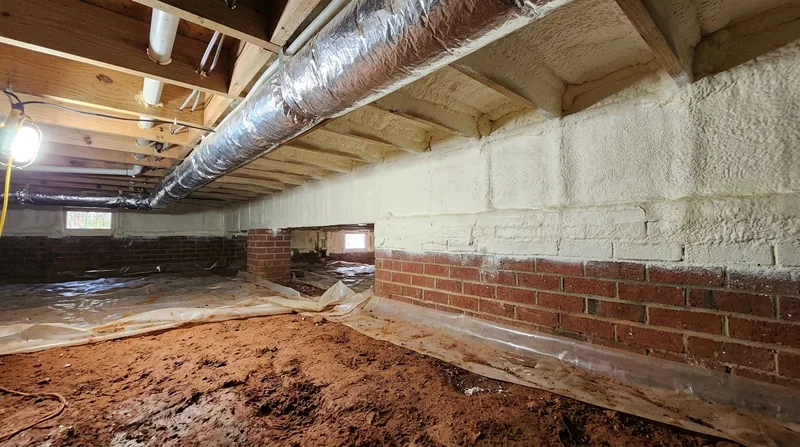




Winston-Salem sits on the rolling red clay of the North Carolina Piedmont, where humidity and moisture pressure define every insulation choice. Most homes here rest on vented crawl spaces raised on brick piers or daylight basements cut into sloped lots, with attics that bake at 130 to 150 degrees Fahrenheit through muggy summers. Closed cell spray foam insulation delivers the vapor retarder and structural stiffness that this climate demands, especially in crawl space walls, basements, and metal buildings where moisture and condensation would otherwise win. We have been helping Winston-Salem homeowners and builders seal and insulate since 2012, and we know the specific failure modes of this region. Two-pound closed-cell foam reads at R-6.5 per inch with its own moisture barrier built in, and it is the right product when Carolina humidity pushes hardest.
Why Closed Cell Spray Foam Matters in Winston-Salem's Humid Climate
The Piedmont climate here is warm, humid, and relentless. Summer air handlers in vented attics work overtime, and crawl spaces under brick pier homes sweat moisture up through red clay year-round. Open-cell foam and fiberglass batts cannot hold back that moisture the way closed-cell does. A sealed crawl space wall or a daylight basement sprayed with closed-cell foam creates a true vapor barrier and stops condensation before it starts. Winter cold snaps off the Blue Ridge foothills make a continuous air seal at the rim joists and band joists worth having, and closed-cell bonds to that framing in a way fiberglass batts cannot. Metal buildings and barndominiums out past the suburbs, especially in Yadkin Valley wine country and the farm belt of Davie and Yadkin County, are notorious for condensation drip without closed-cell protection.
- Closed-cell foam is a true vapor retarder, blocking moisture migration that would rot wood and breed mold in crawl spaces and basements.
- The product stiffens rim joists, band joists, and roof decks, adding real structural bracing to older frame homes on brick piers.
- Metal buildings and pole barns stay dry because closed-cell stops condensation on cold steel, a failure mode that open-cell and blown-in cannot address.
- Sealed attics and vaulted rooms over garages (the FROG) hold temperature without the humidity swings that cause comfort complaints.
- Daylight basements and crawl spaces sealed with closed-cell stay habitable and protect foundation framing from the red-clay moisture that dominates this region.
In Winston-Salem and the surrounding Piedmont, closed-cell foam is not a luxury; it is the insulation that matches the climate and the building stock.
Key info: Crawl spaces under 1920s-1940s Craftsman bungalows in Ardmore, Washington Park, and Waughtown need closed-cell protection because the red clay below them never dries. Metal barndominiums in Bermuda Run and Lewisville sweat condensation without it. Sealed attics over vaulted rooms in Reynolda and Buena Vista stay comfortable year-round because closed-cell stops the humidity that open-cell cannot.
For more on how crawl space insulation protects your foundation, visit our crawl space spray foam insulation page.
How We Spray Closed Cell Foam: The Winston-Salem Process
Closed-cell foam is mixed on site at the precise drum temperature and chemical ratio, sprayed in controlled passes to hit the specified thickness, and cured under mechanical ventilation. We do not rush the job or promise immediate re-entry. The product is low-VOC once fully cured, but the installation itself requires care, and we follow the manufacturer's timeline and the local building code. In Winston-Salem, where humidity is constant and moisture is the enemy, getting the application right is the difference between a job that lasts thirty years and one that fails in five.
- We inspect the substrate (crawl space wall, basement wall, rim joist, attic deck, or metal building frame) and ensure it is dry and clean, or we walk away.
- We set up mechanical ventilation and establish a re-entry window of twenty-four to forty-eight hours, communicated to you in writing.
- We mix the foam at the drum temperature specified by the manufacturer, never guessing or blending hot and cold drums.
- We spray in controlled passes, measuring thickness with a depth gauge to hit the R-value and thickness stated in your written estimate.
- We apply the thermal barrier (drywall, intumescent, or other code-approved material) if required by your local building official.
- We verify the installation with you on site and provide a summary of what was sprayed, where, and at what thickness.
This is not a fast process, and it should not be. The quality of a closed-cell foam job is measured in how long it holds up, not how fast it was done.
Example: A daylight basement in Clemmons with a south-facing wall and a history of moisture seepage gets a 2-inch closed-cell spray (R-13) with mechanical ventilation running for thirty-six hours. The homeowner stays out of the basement during cure and re-enters after the window closes. Two years later, the wall is still dry and the foundation is protected. That is the standard we hold.
If you are considering attic spray foam insulation, closed-cell is often the right choice for sealed or vaulted attics in Winston-Salem where humidity control is critical.
Closed Cell Spray Foam Applications and Methods
| Application | Thickness | Best for |
|---|---|---|
| Crawl space walls | 1.5 to 2 inches (R-10 to R-13) | Blocking moisture from red clay, protecting rim joists and band joists from rot and termite damage |
| Daylight basements | 2 to 3 inches (R-13 to R-20) | Sealing below-grade walls against moisture seepage and temperature loss |
| Metal buildings and barndominiums | 2 to 4 inches (R-13 to R-26) | Stopping condensation drip on cold steel, insulating pole barns and converted tobacco buildings |
| Sealed or vaulted attics | 3 to 6 inches (R-20 to R-39) | Sealing roof decks and eliminating vented attic moisture problems in finished rooms over garages and vaulted ceilings |
| Rim and band joists | 1.5 to 2 inches (R-10 to R-13) | Sealing the junction between rim joist and band joist, the primary air leak in older homes |
Closed Cell Spray Foam Insulation Cost in Winston-Salem: What to Expect
Closed-cell foam in Winston-Salem typically starts at $1.20 to $1.50 per board foot, though the final price depends on the application, the thickness required, site access, and the substrate condition. A crawl space wall sealed with 2 inches of closed-cell might cost $800 to $1,500 depending on the linear footage and whether the space is tight or open. A daylight basement at 2 to 3 inches runs higher, often $2,000 to $4,000 or more if the wall is large or difficult to access. Metal building insulation scales with the square footage and the thickness needed to stop condensation. Sealed attic work over a vaulted room in a newer Clemmons or Lewisville home can run $2,500 to $6,000 or more because sealed attics require thicker foam and thermal barriers.
The best way to understand your cost is to get a written estimate with the R-value and thickness specified for each area. We provide free estimates within twenty-four hours at (336) 608-5235, and we always show you the board footage, the thickness, and the total cost before we spray. For a detailed pricing overview across all our services, see our full pricing page.
Factors that move the price up include difficult access (tight crawl spaces, steep attics, or confined basements), the need for substrate repair or moisture remediation before spraying, the local building code requirement for thermal barriers, and travel time to job sites in rural Yadkin Valley or Stokes County. We include travel to Winston-Salem and surrounding areas with no mileage fee.
What to Look for When Hiring a Closed Cell Spray Foam Contractor Near Winston-Salem
Hiring the right closed-cell foam installer is critical because a bad installation (wrong ratio, poor ventilation, no thickness verification, immediate re-entry promised) will leave you with a job that smells, fails, or worse. When you are comparing contractors near Winston-Salem, look for a few specific markers of competence and honesty. First, ask for a written estimate that names the R-value and thickness for each area. If the estimate is just a price per square foot with no thickness or R-value, that contractor does not know what they are doing or does not want you to check their work. Second, verify that the contractor is fully insured and ask to see the certificate. Third, ask about mechanical ventilation during cure and the re-entry window; any contractor promising immediate re-entry is cutting corners. Fourth, check local permitting requirements with your city or county building department, because attic ventilation rules, thermal barrier requirements, and crawl space regulations vary by address.
- Request a written estimate that specifies the R-value per inch, the thickness in inches, and the total board footage for each application area.
- Ask how long mechanical ventilation will run and what the re-entry window is; the answer should be twenty-four to forty-eight hours, not same-day.
- Verify that the contractor carries full insurance coverage and ask for a copy of the certificate naming your address.
- Get at least two or three estimates so you can compare thickness, R-value, and price, and understand why one bid is higher or lower.
- Check with your local Winston-Salem or county building department to learn what permits, thermal barriers, and attic ventilation rules apply to your address.
- Ask the contractor how they handle a substrate that is wet, contaminated, or actively leaking; the right answer is they will not spray until the moisture is fixed.
A local contractor who can show up on short notice, explain the technical details in plain language, and walk away from a job that is not right is worth more than a low bid from an out-of-state rig-and-run crew. Call us at (336) 608-5235 or request a free estimate online to discuss your specific situation.
Closed Cell Spray Foam Insulation in Winston-Salem: Pricing Guide
| Service | Price | Details |
|---|---|---|
| Crawl space wall sealing | Starting at $1.20/board ft | 1.5 to 2 inches of closed-cell foam on rim joists and band joists; cost scales with linear footage and space access |
| Daylight basement insulation | Starting at $1.30/board ft | 2 to 3 inches on below-grade walls; pricing depends on wall area, substrate condition, and moisture remediation if needed |
| Metal building and barndominium | Starting at $1.20/board ft | 2 to 4 inches to stop condensation on steel; larger square footage and higher thickness increase total cost |
| Sealed attic or vaulted room | Starting at $1.40/board ft | 3 to 6 inches on roof deck; thermal barrier and code compliance add to final cost; larger attics scale up significantly |
| Complex or large-scale job | On estimate | Metal building retrofit, full-home air sealing, or multiple applications require on-site inspection before pricing |
| Free estimate | No obligation | Response within 24 hours at (336) 608-5235; written estimate includes R-value, thickness, and total board footage |
Indicative pricing, the exact cost depends on square footage, finish, and site access. Free personalized estimate within 24h at (336) 608-5235.


