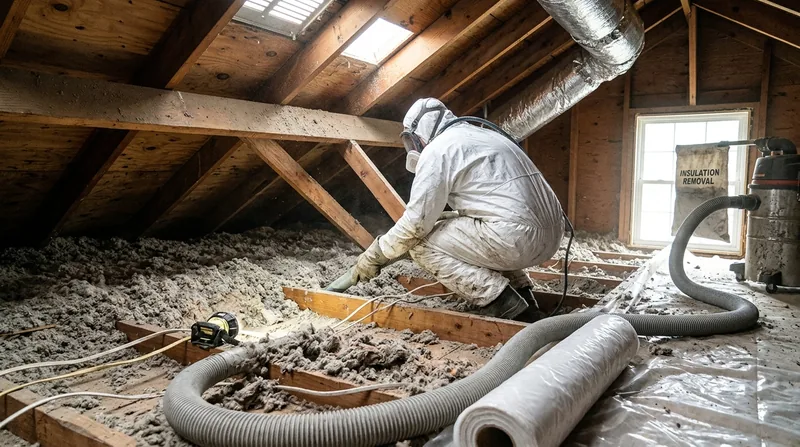




Insulation removal in Winston-Salem is the foundation of every retrofit job worth doing. Homes across the Piedmont, from the 1920s Craftsman bungalows of West End and Ardmore to the split-level ranches of Konnoak Hills and the vaulted rooms of newer subdivisions in Clemmons and Lewisville, sit on a landscape where old blown-in fiberglass, compressed batts, and failed spray foam jobs trap moisture, harbor animal contamination, and block the installation of proper new insulation. The humid subtropical climate and the pressure from squirrels, raccoons, and the occasional bat make removal not just a convenience but a necessity. Insulation removal in Winston-Salem means vacuuming out decades of settled dust, fiberglass, and debris before new foam goes in clean. We remove contaminated material, cut out failed spray foam that other installers will not touch, and flag vermiculite for testing if we find it. The job is the unglamorous work that determines whether a new insulation system will perform or fail. We do it because it is the right thing to do, and because Winston-Salem's climate and building stock demand it.
Why Insulation Removal Matters in Winston-Salem's Humid Climate
The attics and crawl spaces of Winston-Salem homes sit in an environment where humidity and temperature swings are relentless. Summer heat drives moisture into vented attics; winter cold and ice dams push it back down. Old blown-in insulation absorbs and holds that moisture, compressing over decades and losing R-value. Squirrel and raccoon nests collapse into the material, leaving urine and feces that emit ammonia and create health risks. Failed spray foam jobs, sprayed too thick in a single pass or without proper ventilation during cure, shrink away from framing and crack, leaving gaps that bleed conditioned air. Attempting to spray new foam over contaminated or failed material is a waste of money and creates a poor bond that fails within years.
- We vacuum out old blown-in fiberglass, cellulose, and mineral wool before any new insulation is installed.
- We remove animal contamination and sanitize the substrate to prevent odor transfer to new foam.
- We cut out and haul away failed spray foam jobs that other contractors will not touch.
- We flag vermiculite insulation for professional testing and leave it undisturbed if asbestos is suspected.
- We inspect the substrate and address moisture sources before new foam is sprayed.
Clean substrate and proper preparation are the difference between a spray foam job that lasts thirty years and one that fails in five.
Key info: Winston-Salem homes built in the 1950s through 1970s often have flat or minimal attic fill that has settled into a hard crust. Removal exposes the original structure and framing, and allows us to inspect for roof leaks, ice dam damage, and moisture staining that point to why new insulation is needed. A visual inspection during removal reveals problems that an estimate from above the old material would miss.
How We Remove Insulation in Winston-Salem: Step by Step
Insulation removal is a deliberate, methodical process. We bring a commercial-grade vacuum truck with HEPA filtration to manage dust and debris. We seal off the work area to prevent contamination from spreading into living spaces. We remove material in sections, bag it, and haul it to a licensed disposal facility. For failed spray foam, we use hand tools and reciprocating saws to cut it out without damaging framing. We inspect the substrate as we go, documenting moisture, pest damage, and structural issues that affect the scope of the new installation. Once removal is complete, the attic or crawl space is clean, dry, and ready for new spray foam, air sealing, and the performance your home deserves.
- We schedule a free on-site estimate to assess the volume of material, access, and any complications like moisture or structural damage.
- We set up containment and mechanical ventilation to manage dust and protect your home during removal.
- We vacuum or hand-remove insulation in sections, using commercial equipment rated for the job.
- We inspect the substrate for moisture, mold, pest damage, and structural integrity.
- We haul debris to a licensed disposal facility and clean the space.
- We flag any hazardous materials (vermiculite, asbestos) for professional testing or remediation.
- We prepare a written scope for the new insulation and air sealing work to follow.
The entire process respects your schedule and your home. We work during business hours, contain dust and odor, and leave the space ready for the next phase of the job.
Real example: A 1960s split-level in Kernersville with a vented attic over a two-story great room. The original fiberglass had settled to 2 inches and was matted with moisture. The homeowner had a failed spray foam job done by an out-of-state crew five years prior; the foam had shrunk and cracked, leaving 30 percent of the attic unsealed. Our removal exposed the problem, vacuumed the old material, cut out the failed foam, and prepped the space for a proper closed-cell spray foam retrofit that sealed the roof deck and the rim joists of the upper floor. Cost to remove was $1,800. Cost to spray was $4,200. Total energy savings and comfort gain justified both jobs in one year.
Insulation Removal Methods and Approaches
| Approach | Description | Best For |
|---|---|---|
| Vacuum removal with HEPA truck | Commercial-grade vacuum with sealed hose and HEPA filtration. Material is drawn into the truck and transported to a licensed disposal facility. No dust escapes into the home. | Blown-in fiberglass, cellulose, and mineral wool in attics and crawl spaces. Standard for most residential jobs in Winston-Salem. |
| Hand removal and bagging | Manual removal using shovels and hand tools, material placed in heavy-duty bags for disposal. Used when vacuum access is limited or material is heavily contaminated. | Attics with low headroom, crawl spaces with tight access, or when the material is too wet or contaminated for vacuum removal. |
| Failed spray foam removal | Reciprocating saws, pry bars, and hand tools to cut and remove spray foam that has failed, shrunk, or cracked. Requires skill to avoid damaging framing and electrical. | Attics and walls where previous spray foam installations have degraded or left gaps. A service most installers refuse to perform. |
| Vermiculite flagging and containment | Identification and marking of vermiculite insulation without disturbance. Material is left in place and flagged for professional testing or remediation if asbestos is suspected. | Older homes, especially those built before 1980. Vermiculite may contain asbestos and must never be disturbed by untrained crews. |
Each approach is chosen based on the material, the space, access, and what we find during the initial inspection. We never assume the simplest method will work; we look at the job and choose the right tool.
Insulation Removal Cost in Winston-Salem: What to Expect
The cost of insulation removal in Winston-Salem depends on the volume of material, the type of insulation, access to the space, and whether contamination or failed foam is present. A typical attic in a 1,500 to 2,000 square foot home with settled fiberglass runs from $950 to $1,500 for vacuum removal. A crawl space with heavier material or moisture issues may run $1,200 to $2,000. Removal of failed spray foam is quoted on site because the extent of the failure is not known until the old material is partially removed. A two-story colonial in Reynolda with a large attic and a failed foam job might run $2,500 to $3,500 for complete removal and substrate inspection.
The factors that move the estimate up are straightforward: the square footage of the space, the depth and density of the old material, access for the vacuum truck, and the presence of animal contamination or hazardous materials like vermiculite. A single-story ranch in Walkertown with easy attic access and standard blown-in will be less expensive than a two-story with a tight attic and a failed foam retrofit. We provide a written estimate that breaks down the scope, the method, and the timeline before any work begins. See our full pricing overview for detailed ranges on removal and related services.
Getting 2 to 3 estimates is smart practice. A low bid with no detail about method, equipment, or disposal is a red flag. A thorough estimate includes the square footage to be cleared, the removal method, the disposal plan, and the inspection findings that will inform the new insulation scope. Compare the detail, not just the price.
What to Look for When Hiring an Insulation Removal Contractor Near Winston-Salem
Insulation removal is a service that any competent spray foam installer should perform as part of a retrofit job. When you are hiring a contractor near Winston-Salem to remove old insulation before new foam goes in, look for these markers of a professional operation. First, the contractor should be fully insured with general liability and workers compensation coverage that is current and verifiable. Ask to see a certificate of insurance. Second, the estimate should be written, on-site, and specific about the square footage, the removal method, and the disposal plan. A verbal estimate or a price-per-square-foot quote with no mention of access or material type is not enough information. Third, the contractor should ask about your local building department and any permits that apply to the work. In Winston-Salem, Clemmons, Lewisville, and other cities across the Piedmont, some removal jobs do not require a permit, but the contractor should know what applies at your address and should defer to the local building official. Fourth, check references from recent jobs in your area. Ask whether the contractor showed up on time, managed dust and odor, and cleaned up thoroughly. Finally, ask how the contractor will handle any hazardous materials or structural issues that are discovered during removal. The honest answer is that we flag vermiculite for testing, we do not disturb it, and we walk away from jobs with active moisture or roof leaks until the moisture is fixed. That is the answer you want to hear.
Call us at (336) 608-5235 or visit our contact page for a free, no-obligation estimate. We will inspect your space, explain what we find, and give you a clear scope and price before any work begins.
Insulation Removal in Winston-Salem: Pricing Guide
| Service | Price | Details |
|---|---|---|
| Attic blown-in removal (standard) | Starting at $950 | Vacuum removal of settled fiberglass or cellulose from attics up to 1,200 sq ft, includes HEPA filtration and disposal |
| Crawl space insulation removal | Starting at $1,200 | Hand removal and bagging of batts or blown-in material in vented crawl spaces, disposal and substrate inspection included |
| Failed spray foam removal | On estimate | Cut-out of failed or shrunk spray foam using hand tools, requires on-site inspection to determine extent and framing risk |
| Large attic or multi-space removal | On estimate | Two-story homes, vaulted attics, or jobs combining attic and crawl space removal need site visit to assess volume and access |
| Travel and disposal | Included | No mileage fee within Winston-Salem and surrounding service areas, licensed disposal facility fee included in estimate |
| Free estimate | No obligation | Written on-site estimate within 24 hours, call (336) 608-5235 to schedule |
Indicative pricing, the exact cost depends on square footage, finish, and site access. Free personalized estimate within 24h at (336) 608-5235.


